![[NetBSD Logo]](/tnf/resource/NetBSD-headerlogo.png)

Summer of Code results: Display Control and Acceleration
For a second consecutive year I mentored Jeremy Morse for NetBSD's Google Summer of Code project entitled Display Control and Acceleration.
This post will review the goals of the project and present the results.
[Read More] [0 comments]
Summer of Code results: Generic file system mounting
This year I mentored Arnaud Ysmal's Summer of Code project entitled "Generic file system mounting". This post contains a recap of the goals and presents the results.
[Read More] [0 comments]
Interview with Alistair G. Crooks
Our fourth edition of the "discussions with a NetBSD developer" series is a very special one, as we had the chance to talk to Alistair G. Crooks, president of The NetBSD Foundation.
Alistair gave us a historical point of view some of you might be unaware of, explaining "The NetBSD way" while telling us what is his analysis of NetBSD's status today and what he thinks about its future. A must read.
[Read More] [4 comments]
FOSSLC's debate with David Maxwell
On 31 August 2009 our very own David Maxwell is taking part in the Free and Open Source Software Learning Centre's debate 'Which open source license is best?'. Obviously, David is advocating for the BSD License. His opponents are Mike Milinkovich (for EPL License) and Matt Asay (for GPL License).
FOSSLC are allowing the public to participate in the event by either posing their own questions or voting on those already listed. For more information see http://moderator.appspot.com/#15/e=9faeb&t=94b79.
You can show your support by registering to either attend on the day or view the webcast stream.
For more information see the FOSSLC website.
Good luck David!
[0 comments]
Support for Keylocks, an Experimental Feature
Recently, generic support for electro-mechanical multi-position keylocks in the kernel has been added to NetBSD. Such locks can be turned into various positions, usually up to three or four position. They come with a set of keys that are different in so far as not all positions can be reached will all keys (which key can go up to which position is called the "locking program"). With the new keylock support, such locks can be used to tinker with the kernel security, much like the traditional securelevel variable...
[Read More] [0 comments]
Interview with S.P. Zeidler
Here's the third edition of the "discussions with a NetBSD developer" series. This time, we had the chance to talk to S.P. Zeidler, admin and member of pkgsrc-releng.
[Read More] [3 comments]
The NetBSD Blog now available via HTTPS
The NetBSD blog is now available via HTTPS as well as the non-encrypted HTTP protocol.
[2 comments]
Interview with Adam Hamsik
After our first interview with NetBSD-5.0 release engineer Soren Jacobsen, it is now Adam Hamsik's turn to be interviewed by NetBSDfr.
Adam is known for his work on porting LVM tools to NetBSD, and for porting ZFS as part of this year's Google Summer of Code.
[Read More] [2 comments]
Google Summer of Code: Display control and Acceleration
Almost all modern display hardware feature various screen resolutions and some form of 2D hardware acceleration - usually as a "bitblit" function to move pixel data around video memory while the processor does something else. Unfortunately the only facility that can make use of this on NetBSD is X, and even then through it's own device drivers. Other popular operating systems (ie linux) feature accelerated framebuffer consoles and kernel display mode setting, as well as numerous display managers for embedded systems that use hardware acceleration (for example Qt/Embedded or DirectFB).
This project is to create a device independent framework to work with wscons, providing kernel mode setting, accelerated framebuffer console support, and allowing userland applications to use 2D acceleration features. More information about this can be found on the project web page
[Read More] [2 comments]
BSDCan 2009: Kernel Development in Userspace - The Rump Approach
At BSDCan 2009 I gave a presentation about using rump for kernel development. The associated paper has two target audiences:
- regular users who wish to easily learn about how the kernel works without having to setup complex kernel development environments
- kernel developers who wish to learn how to use rump for kernel development and requesting more detailed information from users in problem reports
Downloads:
[0 comments]
Runnable Userspace Meta Programs in NetBSD 5.0
The rump (Runnable Userspace Meta Program) framework, unique to NetBSD, provides lightweight virtualization of kernel components such a file systems and networking. This short article explores the key ideas behind rump and gives examples on how to use rump on NetBSD 5.
[Read More] [0 comments]
NetBSD 5.0: benchmarks and an introduction
I have prepared a presentation giving an overview of some of the new features, technology and performance improvements debuting in NetBSD 5.0. You can find the slides from this presentation here:
A comparison of the scalability and performance improvements found in NetBSD 5.0 was conducted against NetBSD 4.0, Fedora Core 10 and FreeBSD 7.1, and is part of the presentation. An outline is below, but for full details on the tests, please refer to the slides. Please click on the images to view a larger version of each.
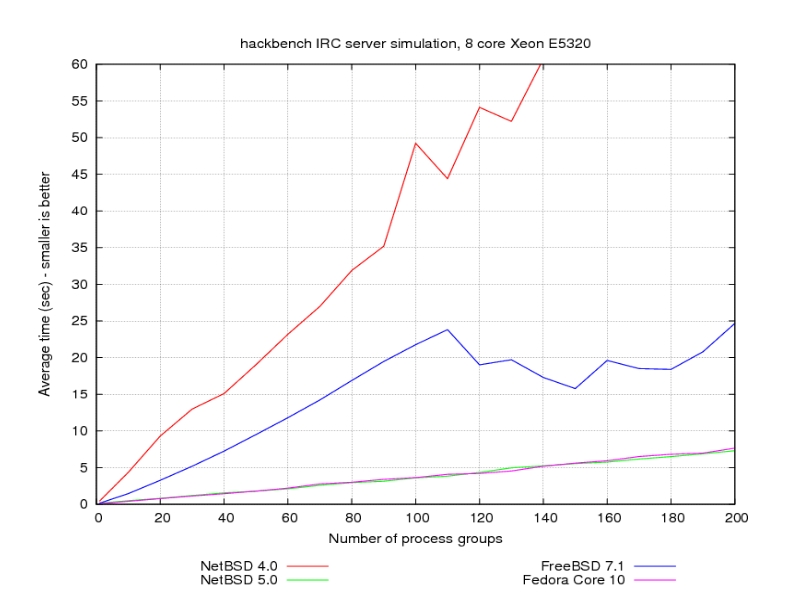
Benchmark: hackbench
This benchmark tests the efficiency and scalability of the scheduler and IPC (inter-process commmunication) mechanisms. It was created by and is popular with Linux kernel developers. Hackbench quickly exposes problems with SMP scaling, and with high numbers of active tasks.
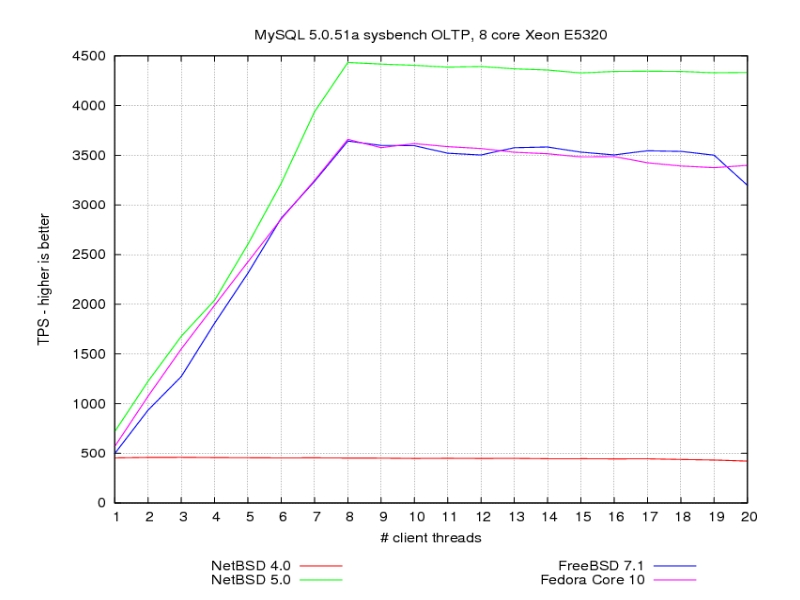
Benchmark: MySQL sysbench
This test simulates an OLTP (OnLine Transaction Processing) style database workload. From the OS developer's viewpoint, it measures the efficiency and scalability of threading, memory allocation, and IPC.
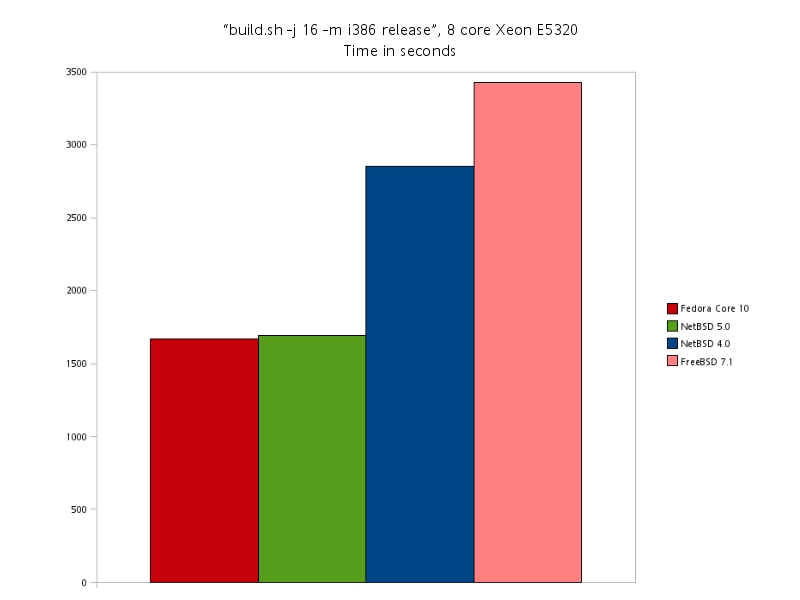
Benchmark: build.sh, NetBSD's build system
This test measures how well the operating system scales when given hosting an intensive software development or shell type workload.
Fedora continues to excel due to the significant investment in improving the efficiency and scalability of Linux over the last few years. Our hats are off to the GNU/Linux/Fedora developers. We aim to reverse the position with the release of NetBSD 6.0.